The Winter Soldier is not just an entertaining film. It is a work of art. Like the best works of art, it provokes intellectually or emotionally; it turns the lens of the camera upon us and asks questions of things that lie beneath the surface. This film's theme might be summarized by Benjamin Franklin's adage (in one particular formulation) "If we restrict liberty to attain security we will lose them both."
During the past several Presidential administrations, the reach of the Federal Government to "attain security"--whether physical, economic, or health--for American citizens (and many non-citizens as well) has increasingly restricted liberty. Just a few examples will suffice: drone strikes on American citizens alleged to be part of terror operations abroad, NSA collection of American citizens' data without individual suspicion or warrant, mandatory payment of Social Security and Medicare taxes into a bankrupt system, mandatory acquisition of government-restricted health insurance, and the militarization of local police forces with surplus military equipment.
The film uses a plot point that the chaos in the world is caused by a villainous organization so as to increase the demand of the people for increased security even at the expense of their own liberty. The heroes learn of this and reinforce their own instincts to preserve liberty, even at the loss of an otherwise logical plan to increase the security of all the people of the world. Would you be willing to exterminate 20 million bad (or potentially bad) people in order to safeguard 7 billion other people, as the film's villains argue? What if it was just a few thousand bad or potentially bad people, in order to safeguard 350 million?
The art of the film is in the asking of its audience to consider this question carefully. The goal of the villains is portrayed as reasonable, though resorting to violence is their general means. We might be tempted to agree with the goal and to support those who would lead us to accomplish it, no matter the means. Yet the producer asks us to consider also the choice of the hero, which is not antithetical to the villains' goal, merely to the means employed. The hero accepts one human imperfection (individual villainy) over another (government villainy). Interestingly, he is given the opportunity to appeal directly to individuals within the government, who then have the chance to make a more informed choice.
If The Winter Soldier makes you think about what our government is doing, and what it should be doing, then it is successful no matter how you side on the issue. This film strongly suggests that you come down on the side of liberty, but leaves open the question of how to best balance liberty and security. Ultimately, it is the conversation to answer that question that we must have, and which the film provokes.
Saturday, April 26, 2014

Monday, July 1, 2013
The Nature of Politics
Yet de Jouvenel's teaching also reminds us that resistance to power is always difficult and rare. Liberal[1] political philosophy asks, "How can naturally free human beings be brought to obey?" but for de Jeuvenel, this is the wrong question. Political authority is natural, and human beings have a high "propensity to comply." Political science, consequently, should be more concerned with the questions, "How do human beings become free? What prompts them to resist a power which defies law?"
Freedom and right resistance, de Jeuvenel indicates, derive from a sense of what is fitting, a conviction that some things are unseemly even when commanded by authority or power. In this view, liberty's proper name is dignity. Even if we concede that freedom is doing as one wants, it is also true that free people want, and will strive for, control over their own wants. Human beings are not free if they are merely automatons pursuing desires even if that pursuit is successful. Freedom presumes the ability to evaluate ends; even more, it requires the kind of courage which enables one to do what is honorable and scorn what is shameful despite the bribes and torments of power.
From the Foreward by Wilson Carey McWilliams to The Nature of Politics: Selected Essays of Bertrand de Jeuvenel.
[1] "Liberal" in this case is used in the original sense, meaning "advocating liberty". This is still the European sense, but has taken on the opposite meaning in the United States. The modern U.S. word "libertarian" (small L) is closest in meaning.
I thought it appropriate to excerpt these paragraphs as we approach Independence Day. Described is not merely the politics practiced among politicians. It also describes our relationship to our government and how we respond to incentives (positive and negative) designed to shape our behavior.
As I look at our incredibly dysfunctional and astonishingly intrusive Federal Government, I cannot help but wonder if Independence Day is an archaic celebration. After all, our forebears threw off George III for far less. We the People have voted for successive governments that have layered the intrusion a little bit every year since the 1930's. Districts and States have sent back virtually the same representatives and senators year after year, with most of them being captured by the system, perpetuating and expanding it.
We the People have lost control. We lost it a long time ago. Now bureaucracy, like a successful fusion reaction, is generating it's own power. They don't need us any more. If we cut off any finding, the sky--we are warned--will fall, children will die, unimaginable bad things will happen. And so our elected officials restore funding, and wonder how to get out of this mess without committing political suicide, and the fusion reaction goes on.
"Resistance to power is always difficult and rare," we read above. Our Founding Fathers wrote the Declaration of Independence to articulate their resistance. They hoped that revolution would be rare, but expected it to occur at some point, even for the government that they later designed for the nation they at last founded despite the odds against them.
The power is not merely politicians who would break the law to gain and keep power. It is also the bureaucracy that gradually strangles the people by regulations--which by law must ensure equal treatment to similarly situated people--that must prescribe everything to an inflexible degree, and penalize any non-compliance with zero-tolerance and a heavy hand. "Human beings are not free if they are merely automatons pursuing desires even if that pursuit is successful." We are being made into automatons, by following the increasingly detailed regulations of the government.
"How do human beings become free? What prompts them to resist a power which defies law?" Our current Federal Government is so obviously operating beyond the enumerated powers, clearly explained in plain language by the Founding Fathers in speeches and essays as they hoped to persuade people of the several states to approve the Constitution. Our bureaucracy defies the Constitution. The President (present and past) orders the bureaucracy to implement actions not authorized by Congress. Our bureaucracy defies the laws passed by Congress.
How do we become free? How do we become independent from this power which defies law?
When you know the answer to that and achieve it, you can then say,
Happy Independence Day.
Thursday, January 3, 2013
On the absurdity of the debt ceiling
Around the table last week, we opined that the Republicans should allow the U.S. to go over the fiscal cliff (thereby broadening the tax base) and by supporting any spending bill the President offered, subject only to the debt ceiling. The thinking was that it would force President Obama to offer real cuts in spending, and hang round his neck the consequences of making spending choices. Alas, I do not think that the Republicans have a trump card in the debt ceiling, and their efforts to negotiate as if they have it will be painful to watch and fruitless in gaining any significant and necessary spending cuts.
I have come to the conclusion that the debt ceiling is a sham in the way it is implemented. It is being used to say that spending in excess of the debt limit is unlawful, even if Congress appropriated funds exceeding revenues such that the addition of the deficit to existing debt exceeds the debt limit. As such, the President is put into the dilemma of choosing to spend appropriated funds (mentioned in the Constitution) in excess of the debt limit (not mentioned in the Constitution, but deriving from a Constitutional power). In my world, and I suspect in President Obama's, the explicit Constitutional provision trumps derived laws.
The power to issue debt was initially given solely to Congress. In 1917 and subsequent years, Congress delegated that authority to the Treasury but established a debt ceiling in order to control total borrowing. Beginning in 1979, the House of Representatives began automatically raising the ceiling by the amount of deficit in each year's budget law. (The Senate has no such rule and must raise the ceiling separately.) [1]
I assert that appropriations funded by deficits implicitly raises the actual debt ceiling. To artificially cap the limit in law begs for legal conflict.
Most entitlements and a majority of Federal spending are permanently and automatically appropriated. In 2008, approximately 53% of all Federal spending was automatically appropriated. [2] With this foundation of automatic appropriations, Congress can appropriate no discretionary spending and still cross the debt ceiling. Is the President responsible if this happens? Why then is the President responsible if the government spends discretionary appropriations in excess of the debt limit? The Constitution does not recognize a difference in appropriations.
I can conclude only that the Congress bears sole responsibility for breach of the debt limit, because they alone can appropriate beyond the debt limit . But since Congress appropriated the funds according to the Constitution, and since the Constitution is the supreme law of the land, then the debt limit law is inferior and does not control either Congress or the Treasury in spending appropriated funds.
I suspect that President Obama's administration has come to the same conclusion and is now deciding whether and how to apply it when the debt limit is reached. He said on January 1st of this new year, "I will not have another debate with this Congress over whether or not they should pay the bills that they've already racked up." [3] For myself, I will agree that he is not responsible for exceeding the debt limit, and that the Treasury should continue to pay the bills the government has obligated itself to pay. For the rest of the country, there will be a civil war of words and cry of impeachment.
My advice to my countrymen: Blame Congress. Tell them to stop automatic appropriations and to hold themselves subject to the debt limit when appropriating funds. It is stupid to tell the President to Spend but not to Borrow when Spending exceeds Revenue, both of which are under Congress' control.
My second advice to my countrymen: Blame ourselves. We put the people in office who set up these arrangements, and we haven't removed even the worst offenders. Part of the reason is in the distributed design of our electoral system (which has very strong merits in other contexts), but most of it is in our failure to only elect honest and effective men and women to office who will adhere to the Constitutional limitations established at our country's founding. Until we change ourselves for the better, we should expect nothing better from our Congress.
References:
[1] http://en.wikipedia.org/wiki/United_States_public_debt#Debt_ceiling
[2] http://en.wikipedia.org/wiki/United_States_federal_budget#Mandatory_spending_and_entitlements
[3] http://www.usatoday.com/videos/news/politics/2013/01/02/1803421/
Friday, August 31, 2012
2012 Republican National Convention
I finally got a chance to watch the Republican National Convention. I have had to resort to transcripts and excerpts before today.
We started the evening by spending Date Night watching the new movie 2016. I was unfamiliar with the "anti-colonial" model of President Obama, and it certainly makes more sense than "Muslim" or "Socialist", although these might yet be true.
We made it home just before 10PM in time to catch the introductory speeches. Clint Eastwood did indeed show up and made a few well-placed extemporaneous comments, plus a small comedy routine with an empty chair in which President Obama was imagined to be sitting for an interview. I wasn't sure if he was prepared enough, but he seemed to remember his outline and stuck to it. This speech was unusual in that it was not squeaky clean and polished, and so represented a big risk of flopping on the most important night of the convention. Kudos to the RNC for taking the risk, and kudos to Eastwood for pulling it off without "screwing the pooch."
Eastwood was followed by Senator Marco Rubio, who delivered an excellent defense of the philosophy that is America. I am familiar with the term "American Exceptionalism", and I believe that Rubio is one of the finest evangelists of this philosophy. I have read in many comments written to online articles in which many Europeans question the validity of American Exceptionalism. I think they miss the fact that today their nations are more like America, and so what was once exceptional now seems less so. Yet there are many nations still who have not achieved the systematic freedom we take for granted, and so it takes someone like Rubio, whose family's life story treads the path from tyranny to freedom, to remind us of our virtue.
What most resonated with me was Rubio's description of his father and mother working long hours following emigration from Cuba so that he and his siblings and their offspring might have a better life. My wife Kathy's grandfather emigrated from Hungary following World War 2. The story of their departure on foot from Budapest as the Soviets closed on the city is one of fear, of utter fatigue, of the strength of kinship, and of total sacrifice. Her father and uncle made that trip as children, riding in a cart pulled by their uncle's cavalry horse. Her grandfather had been a respected attorney in Hungary, but could not find any such work in the United States. Yet he persevered in whatever he could do, and his children built incredible families and futures, and their childrens' destinies are secure after three generations of accumulated hard work. In America, it is possible to succeed, even if you start with nothing. It takes education and industry and time, but America holds open the wide gate of opportunity to all comers. The element of time is what I think the Liberals miss; it's as if they want everything for everyone now, even though it takes one or more lifetimes to build and maintain success.
Romney's speech was good. Reagan might have given something more stellar, but I will not complain. In many ways, Reagan spoiled the speech-giving process for many politicians that came after, because he made it look so easy and did it so well. But Romney hit all the bases, used a dash of humor here and there, and got his audience participating in a few back-and-forth sessions. I learned a few things about him tonight, specifically about his father and the impact that his immigrant heritage had on him.
Kathy has really grown politically. I saw her nodding vigorously a few times during 2016, and Rubio's speech clearly moved her as well. She does not have the time to follow the news, so her dad and I do what we can to send her online news. As a result, she learned a great deal about Romney tonight, and is far more comfortable with him than with Obama. She is a small businesswoman through and through after seven long years. She still doesn't have a salary--hopefully next year--and she doesn't want to be demonized when she does. We've put a lot of effort into our business, and no one can give us back those years or take credit away. We are pleased that Romney and Ryan praise us for the work that we put in, and the jobs that we created, and the customers that receive valuable goods and services through and from us. We grow the economy; we don't take from someone else in a zero-sum game. If Obama understood this and communicated it through his words and actions, then his policies would look radically different and would be more likely to succeed.
We're looking forward to the debates. We're hoping that Paul Ryan can keep Joe Biden from disarming him by turning everything into a joke. If he can, then Ryan will clobber Biden. As to the Romney-Obama debates, we hope that the they are not a complete farce like all the rest have been over the last several presidential election cycles. We really liked the format that Mike Huckabee used for the Republican candidates, by using states' attorneys general to ask the questions and press them home one candidate at a time independently. The field could be widened to have questioners include business people, skilled and trade laborers, state and local government officials, educators, retired military, and so on. We'd find a lot more about the candidates than letting them spar under the most artificial rules and time constraints.
We started the evening by spending Date Night watching the new movie 2016. I was unfamiliar with the "anti-colonial" model of President Obama, and it certainly makes more sense than "Muslim" or "Socialist", although these might yet be true.
We made it home just before 10PM in time to catch the introductory speeches. Clint Eastwood did indeed show up and made a few well-placed extemporaneous comments, plus a small comedy routine with an empty chair in which President Obama was imagined to be sitting for an interview. I wasn't sure if he was prepared enough, but he seemed to remember his outline and stuck to it. This speech was unusual in that it was not squeaky clean and polished, and so represented a big risk of flopping on the most important night of the convention. Kudos to the RNC for taking the risk, and kudos to Eastwood for pulling it off without "screwing the pooch."
Eastwood was followed by Senator Marco Rubio, who delivered an excellent defense of the philosophy that is America. I am familiar with the term "American Exceptionalism", and I believe that Rubio is one of the finest evangelists of this philosophy. I have read in many comments written to online articles in which many Europeans question the validity of American Exceptionalism. I think they miss the fact that today their nations are more like America, and so what was once exceptional now seems less so. Yet there are many nations still who have not achieved the systematic freedom we take for granted, and so it takes someone like Rubio, whose family's life story treads the path from tyranny to freedom, to remind us of our virtue.
What most resonated with me was Rubio's description of his father and mother working long hours following emigration from Cuba so that he and his siblings and their offspring might have a better life. My wife Kathy's grandfather emigrated from Hungary following World War 2. The story of their departure on foot from Budapest as the Soviets closed on the city is one of fear, of utter fatigue, of the strength of kinship, and of total sacrifice. Her father and uncle made that trip as children, riding in a cart pulled by their uncle's cavalry horse. Her grandfather had been a respected attorney in Hungary, but could not find any such work in the United States. Yet he persevered in whatever he could do, and his children built incredible families and futures, and their childrens' destinies are secure after three generations of accumulated hard work. In America, it is possible to succeed, even if you start with nothing. It takes education and industry and time, but America holds open the wide gate of opportunity to all comers. The element of time is what I think the Liberals miss; it's as if they want everything for everyone now, even though it takes one or more lifetimes to build and maintain success.
Romney's speech was good. Reagan might have given something more stellar, but I will not complain. In many ways, Reagan spoiled the speech-giving process for many politicians that came after, because he made it look so easy and did it so well. But Romney hit all the bases, used a dash of humor here and there, and got his audience participating in a few back-and-forth sessions. I learned a few things about him tonight, specifically about his father and the impact that his immigrant heritage had on him.
Kathy has really grown politically. I saw her nodding vigorously a few times during 2016, and Rubio's speech clearly moved her as well. She does not have the time to follow the news, so her dad and I do what we can to send her online news. As a result, she learned a great deal about Romney tonight, and is far more comfortable with him than with Obama. She is a small businesswoman through and through after seven long years. She still doesn't have a salary--hopefully next year--and she doesn't want to be demonized when she does. We've put a lot of effort into our business, and no one can give us back those years or take credit away. We are pleased that Romney and Ryan praise us for the work that we put in, and the jobs that we created, and the customers that receive valuable goods and services through and from us. We grow the economy; we don't take from someone else in a zero-sum game. If Obama understood this and communicated it through his words and actions, then his policies would look radically different and would be more likely to succeed.
We're looking forward to the debates. We're hoping that Paul Ryan can keep Joe Biden from disarming him by turning everything into a joke. If he can, then Ryan will clobber Biden. As to the Romney-Obama debates, we hope that the they are not a complete farce like all the rest have been over the last several presidential election cycles. We really liked the format that Mike Huckabee used for the Republican candidates, by using states' attorneys general to ask the questions and press them home one candidate at a time independently. The field could be widened to have questioners include business people, skilled and trade laborers, state and local government officials, educators, retired military, and so on. We'd find a lot more about the candidates than letting them spar under the most artificial rules and time constraints.
Friday, June 1, 2012
Expanding and Contracting the definition of "Marriage"?
A recent letter to the editor (not by me) entitled by the editor "If gays, lesbians marry, why not relatives?" related the defense given by many, that "two consenting adults [have constitutional rights] to marry whom they love". The author of the letter took issue with this defense, logically concluding that it could be used as justification for incestuous marriage. Readers of the letter were not kind, calling this a "slippery slope" and calling the comparison of same-sex marriage with incestuous marriage a "nonsense argument".
My interpretation is that the readers overreacted. In their rush to defend same-sex marriage, they overlooked the actual thesis of the letter. The letter took issue with the simplistic defense, not with the actual merits of same-sex marriage. My efforts to defend the author on these grounds were themselves attacked (with some bringing in the topics of cannibalism and rape), as if I too had stated that same-sex marriage was equivalent to incestuous marriage (or rape or cannibalism).
After a little back and forth, a real debate emerged. My opponent cited the 14th Amendment to the U.S. Constitution, whose "Equal Protection Clause" reads
He reasonably simplified this clause as "similarly-situated citizens must be treated the same by the State," and asserted that same-sex couples were similarly situated to opposite-sex couples, and that incestuous couples and polygamous couples are not similarly situated. His assertion led me to point out that people are most likely to disagree whether same-sex couples are in fact similarly situated.
The disagreement should involve statements regarding the State's fundamental interest in promoting the effects of marriage; for, why would the State erect such a powerful legal framework of inheritance, medical rights, incentives for generating offspring and responsibilities for rearing them, etc.? Surely not merely to protect the right of two consenting adults to join in a contract.
The most significant and irrefutable difference between same-sex couples and opposite-sex couples has to do with reproduction. It is a fact that same-sex couples cannot naturally create offspring wholly within the circle of their own inherent biological capabilities. It requires human intervention from outside the circle, such as through sperm or egg donation, or the use of a surrogate parent. (It can be argued that many opposite-sex couples must resort to these methods as well, but as a class, opposite-sex couples together have the reproductive capability that same-sex couples do not.)
The question arises: Is reproduction one of the State's fundamental interests in promoting opposite-sex marriage? If so, is the absence of this ability in part of the population, especially in today's age of advanced reproductive technology and a legal system sympathetic to artificial reproduction, sufficient to declare same-sex couples "not similarly situated" and so deny the right to marry? Reasonable people will disagree, and hostile debate will not bring the many sides closer to understanding. This is a matter of philosophy, not of fact.
It would seem that in all other ways, same-sex couples are similarly situated. They share a desire with opposite-sex couples for a special familial integration, recognized with the full majesty and force of law, of two lives full of income and property, offspring (whether adopted or not), and the power to make joint decisions and be a pre-eminent part of each other's lives.
Civil Unions were introduced to offer this second, more sweeping, legal aspect of marriage, but is argued by many to be inadequate because the institution is "separate but equal" to marriage. To determine why they are separate, it is necessary to determine what the State's justification is for promoting marriage, as opposed to allowing civil unions. It is for the people of each State to decide the answer to that question, and the rationale used to answer the question matters, which brings us back to the author of the letter to the editor.
If marriage is justified solely in legal terms, resting especially on the general right of consenting adults to contract with one another as they choose, then it should come as no surprise when any consenting adults wish to enter into any contract with one another as they choose. It is still reasonable for the State to determine the extent to which such a contract is legal, but the State must justify each limitation, and that may be scientific (as with incestuous relationships), or social-scientific (as with polygamous relationships).
If, however, some justification is couched in philosophical terms (whether in addition to or in lieu of scientific or social-scientific evidence), then the contractual limits may be arbitrary, subject only to the collective will of the electorate. This is, I believe, where the same-sex marriage debate actually stands. The will of the electorate of the past is being challenged in legislatures and courthouses by the electorate of today. Some State legislatures have embraced same-sex marriage (though often at the prompting of the judiciary); others have rejected it, even to the extent of enshrining their opposition with that of the electorate directly into their State constitutions.
The people are speaking. Some have determined that same-sex couples are similarly situated to opposite-sex couples. In this respect, I believe that they have contracted the definition of marriage, by eliminating** the possible justifications that the State may have for promoting only opposite-sex marriage. They have, however, expanded the number of people eligible to be married, and so this is likely the source in popular usage of "expansion of marriage rights". (**It is possible that new justifications specific to same-sex couples could be added, but I have not observed these. Equality of same-sex couples seems to be the primary reason, not their superiority; the superiority of opposite-sex couples has been claimed by many opposite-sex marriage proponents.)
Likewise, some have determined that same-sex couples are not similarly situated. Whether these people have expanded or restored or clarified the definition of marriage is difficult to say, as the definition of marriage comes down to us from so many different paths through history, and is touched by both fact and falsehood.
It would be sufficient, in an ideal sense, that both of these groups of people, both pro and con, have chosen to re-examine their personal justifications for marriage and collectively written new definitions that are acceptable to them in their States. In truth, perhaps many have undertaken this re-examination with solemn conviction, but likely many others have reacted from lesser motivations, ranging from ignorance to selfish desire. I lament that so many on opposing sides reduce to hurling insults and epithets, and arguing only on emotional grounds, none of which serves the common interest, and all of which disrespects someone's individual interest. Once again, the limitations of representative democracy reveal the flaws in our system of government as it has evolved to the present day.
In all cases, oversimplification of the arguments for or against same-sex marriage, especially when enshrined in law, can lead to heretofore absurd or undesired conclusions. Get educated on the complexity of the arguments, and form studied opinions before rendering them.
My interpretation is that the readers overreacted. In their rush to defend same-sex marriage, they overlooked the actual thesis of the letter. The letter took issue with the simplistic defense, not with the actual merits of same-sex marriage. My efforts to defend the author on these grounds were themselves attacked (with some bringing in the topics of cannibalism and rape), as if I too had stated that same-sex marriage was equivalent to incestuous marriage (or rape or cannibalism).
After a little back and forth, a real debate emerged. My opponent cited the 14th Amendment to the U.S. Constitution, whose "Equal Protection Clause" reads
[N]or shall any State ... deny to any person within its jurisdiction the equal protection of the laws.
He reasonably simplified this clause as "similarly-situated citizens must be treated the same by the State," and asserted that same-sex couples were similarly situated to opposite-sex couples, and that incestuous couples and polygamous couples are not similarly situated. His assertion led me to point out that people are most likely to disagree whether same-sex couples are in fact similarly situated.
The disagreement should involve statements regarding the State's fundamental interest in promoting the effects of marriage; for, why would the State erect such a powerful legal framework of inheritance, medical rights, incentives for generating offspring and responsibilities for rearing them, etc.? Surely not merely to protect the right of two consenting adults to join in a contract.
The most significant and irrefutable difference between same-sex couples and opposite-sex couples has to do with reproduction. It is a fact that same-sex couples cannot naturally create offspring wholly within the circle of their own inherent biological capabilities. It requires human intervention from outside the circle, such as through sperm or egg donation, or the use of a surrogate parent. (It can be argued that many opposite-sex couples must resort to these methods as well, but as a class, opposite-sex couples together have the reproductive capability that same-sex couples do not.)
The question arises: Is reproduction one of the State's fundamental interests in promoting opposite-sex marriage? If so, is the absence of this ability in part of the population, especially in today's age of advanced reproductive technology and a legal system sympathetic to artificial reproduction, sufficient to declare same-sex couples "not similarly situated" and so deny the right to marry? Reasonable people will disagree, and hostile debate will not bring the many sides closer to understanding. This is a matter of philosophy, not of fact.
It would seem that in all other ways, same-sex couples are similarly situated. They share a desire with opposite-sex couples for a special familial integration, recognized with the full majesty and force of law, of two lives full of income and property, offspring (whether adopted or not), and the power to make joint decisions and be a pre-eminent part of each other's lives.
Civil Unions were introduced to offer this second, more sweeping, legal aspect of marriage, but is argued by many to be inadequate because the institution is "separate but equal" to marriage. To determine why they are separate, it is necessary to determine what the State's justification is for promoting marriage, as opposed to allowing civil unions. It is for the people of each State to decide the answer to that question, and the rationale used to answer the question matters, which brings us back to the author of the letter to the editor.
If marriage is justified solely in legal terms, resting especially on the general right of consenting adults to contract with one another as they choose, then it should come as no surprise when any consenting adults wish to enter into any contract with one another as they choose. It is still reasonable for the State to determine the extent to which such a contract is legal, but the State must justify each limitation, and that may be scientific (as with incestuous relationships), or social-scientific (as with polygamous relationships).
If, however, some justification is couched in philosophical terms (whether in addition to or in lieu of scientific or social-scientific evidence), then the contractual limits may be arbitrary, subject only to the collective will of the electorate. This is, I believe, where the same-sex marriage debate actually stands. The will of the electorate of the past is being challenged in legislatures and courthouses by the electorate of today. Some State legislatures have embraced same-sex marriage (though often at the prompting of the judiciary); others have rejected it, even to the extent of enshrining their opposition with that of the electorate directly into their State constitutions.
The people are speaking. Some have determined that same-sex couples are similarly situated to opposite-sex couples. In this respect, I believe that they have contracted the definition of marriage, by eliminating** the possible justifications that the State may have for promoting only opposite-sex marriage. They have, however, expanded the number of people eligible to be married, and so this is likely the source in popular usage of "expansion of marriage rights". (**It is possible that new justifications specific to same-sex couples could be added, but I have not observed these. Equality of same-sex couples seems to be the primary reason, not their superiority; the superiority of opposite-sex couples has been claimed by many opposite-sex marriage proponents.)
Likewise, some have determined that same-sex couples are not similarly situated. Whether these people have expanded or restored or clarified the definition of marriage is difficult to say, as the definition of marriage comes down to us from so many different paths through history, and is touched by both fact and falsehood.
It would be sufficient, in an ideal sense, that both of these groups of people, both pro and con, have chosen to re-examine their personal justifications for marriage and collectively written new definitions that are acceptable to them in their States. In truth, perhaps many have undertaken this re-examination with solemn conviction, but likely many others have reacted from lesser motivations, ranging from ignorance to selfish desire. I lament that so many on opposing sides reduce to hurling insults and epithets, and arguing only on emotional grounds, none of which serves the common interest, and all of which disrespects someone's individual interest. Once again, the limitations of representative democracy reveal the flaws in our system of government as it has evolved to the present day.
In all cases, oversimplification of the arguments for or against same-sex marriage, especially when enshrined in law, can lead to heretofore absurd or undesired conclusions. Get educated on the complexity of the arguments, and form studied opinions before rendering them.
Monday, December 19, 2011
How to prevent licking an abdominal incision
Scarlett recently had surgery to remove a cancerous skin tumor from her abdomen. She was absolutely pitiful with the e-collar, so Kathy first used a long-sleeve shirt with a dog cape to keep Scarlett's tongue from the stitches. We upgraded stylistically to flannel this evening, and should trip Scarlett less than the prototype did. It's cute, and it means we get a full night's rest (unlike the first night, when I slept on the floor with her sans e-collar).

Prototype

Prototype

Thursday, November 10, 2011
Occupy "Here" Disappointment
I have been very disappointed in the immaturity and criminality associated with the "Occupy" movement. Having been to at least one Tea Party rally, I can attest to the sharp difference between the two crowds.
Although both are rightfully (to an extent) railing against financial excesses, the "Occupy" movement seems to have misunderstood their civic right to peaceably assemble and petition for redress of grievances. Whereas the Tea Party rallies emboldened people to go home and seek electoral change, the "Occupy" movement seems to be stuck in urban locations making a nuisance.
The level of crime that has sprung up around these camps is more than sufficient to demonstrate a stark difference from the Tea Party rallies. We should be as shocked about the crimes happening in the camps as we are about the child abuse that occurred at Penn State.
We should celebrate our right to assemble, but show disdain for those who abuse it. We cannot--and should not--send them to jail for assembling. But we can turn our backs on them, and we can support Mayors who work to arrest the lawbreakers.
Although both are rightfully (to an extent) railing against financial excesses, the "Occupy" movement seems to have misunderstood their civic right to peaceably assemble and petition for redress of grievances. Whereas the Tea Party rallies emboldened people to go home and seek electoral change, the "Occupy" movement seems to be stuck in urban locations making a nuisance.
The level of crime that has sprung up around these camps is more than sufficient to demonstrate a stark difference from the Tea Party rallies. We should be as shocked about the crimes happening in the camps as we are about the child abuse that occurred at Penn State.
We should celebrate our right to assemble, but show disdain for those who abuse it. We cannot--and should not--send them to jail for assembling. But we can turn our backs on them, and we can support Mayors who work to arrest the lawbreakers.
Saturday, November 5, 2011
Scottish Stormtropper

Photographed last weekend at the Highland Games and Celtic Festival at the Meadow Event Park in Caroline County, Virginia.

Tuesday, August 23, 2011
Even the earthquakes are leaving California
Yesterday and today, Colorado had significant earthquakes. Today, Virginia had a 5.9 quake about an hour's drive from my home.
Perhaps taxpayers are not the only ones leaving California!
Perhaps taxpayers are not the only ones leaving California!
Sunday, August 21, 2011
Journalistic Misuse of Photography: Example

(JOHN GILES/ASSOCIATED PRESS)
The above picture appears at the head of Ezra Klein's article "Getting ready for a wave of coal-plant shutdowns".
I want to take issue with what I think is a misleading use of photography in a journalistic setting. First, my qualifications: I am a competent amateur photographer, I live near two clean-coal plants, and have toured one of them as a volunteer firefighter.
This picture is tied to comments about coal-fired power plants being idled and remaining coal-fired power becoming more expensive as a result of new EPA regulations. The picture appears at first to be of a dirty smoke pouring out of the stack. This simply is not true. The stack in question is a water-spray column through which smoke is directed *after* it has gone through a first-stage ash filter. (The ash is often consumed by landfills and concrete manufacturers.) The cloud emerging from the stack is in fact nothing more than steam. (There are invisible gases emerging as well, such as Carbon Dioxide.)
The photographer has imaged the cloud with the sun behind it. Then using exposure bracketing, he has formed a High Dynamic Range photo, which enhances the shadowed areas without blowing out the bright areas. This leads to simple white steam appearing dark and fringed by white.
In the winter, this steam lingers along the wind for thousands of feet before finally behind cooled and absorbed into the air. In summer, the steam is rarely visible more than a few hundred feet, except when high humidity in the air--such as during a heavy rain storm--prevents rapid absorption of the humidity.
In short, the photograph displayed is completely misused for the article to which it is applied. It is a lapse of editorial integrity to combine the two.
Thursday, July 14, 2011
A Question of Procedure
In congress, ordinary procedure calls for a bill to be submitted to committees having jurisdiction over the subject area. Once the committees have amended the bill, if they approve, then the bill will go to the floor to be amended again, then voted up or down (or sometimes pulled from consideration).
Watching the Congress and the President wrestle over the debt ceiling and the deficit is like watching bad theater. None of this is business as usual. There are 435 members in the House of Representatives, and 100 senators in the Senate. Each is assigned to various committees and subcommittees. The budget committees have proper jurisdiction over the level of appropriations, and should be the ones doing the heavy lifting in this time of "crisis." They are not, and so we have stepped away, yet again, from normal procedure.
I say "yet again" because Speaker Pelosi bypassed the committees several times to get what she wanted. This represents yet another critical breakdown in the legislative process.
What should be happening? How about this:
1) The Democrats in the House draft a revenue bill plus debt ceiling increase and work to bring it to the floor for a vote. The Republicans let them, knowing that they have the overwhelming "Nay" votes.
2) The Senate cannot constitutionally bring forward a revenue bill, so the Democrat-controlled Senate is limited to formulating and voting on a spending reduction plus debt ceiling increase bill. The Republicans work to shape the bill, but do not filibuster.
3) The House proceeds to consider Republican and/or Democrat spending reduction plus debt ceiling increase bills. One of these will pass, probably the Republican bill.
4) The two chambers appoint a joint committee to reconcile the two bills. Many concessions are discussed, and either the committee comes to agreement or it does not. If it comes to agreement, then both chambers attempt to pass the jointly-revised bill. Otherwise, the bill is dead.
5) If both chambers pass the revised bill, then it goes to the President for signature. If he doesn't like it, he vetoes it. Otherwise, he lets it pass into law.
6) If the President vetoes the bill, then the Congress must vote to override it. To muster veto-proof support, the bill must be palatable to 2/3 of each chamber, a good definition of bipartisanship.
7) If Congress cannot override the veto, then the bill is dead.
So, at which point in the process is it who's fault if the bill does not pass? In truth, everyone's prints are all over the corpse, and all are responsible. Republicans are responsible if they produce a bill that the Senate cannot reconcile to. Democrats are responsible if they produce a bill that the House cannot reconcile to. The President is responsible if a reasonable majority approve a critical bill and he vetoes it.
The American people aren't supposed to know the ins and outs of legislative procedure. What's in the Constitution is a good enough, high-level description. But we should know that the procedure is fair and representative, and that it is deviated from only in times of great national danger.
What is happening now is a government-made national danger. It is shameful that reckless spending and borrowing have occurred and have now brought us to this point. It is imperative to re-infuse the process with representativeness and fairness.
Following an expedited form of the process above would give Democrats in the House something that Speaker Pelosi refused to give Republicans in the House: a fair chance to have their legislation voted up or down. If they want tax increases, then let them try to muster enough support for a vote. If it fails, proceed with the only option that remains: spending reductions.
Above all, let the voice of the people, through their Representatives in the House, be heard by the Senate and the President. Let the opposition stand aside when they lose the vote. Let the victor move forward confidently and with humility when they win the vote.
Maybe then, we'll get a functioning legislative branch.
Watching the Congress and the President wrestle over the debt ceiling and the deficit is like watching bad theater. None of this is business as usual. There are 435 members in the House of Representatives, and 100 senators in the Senate. Each is assigned to various committees and subcommittees. The budget committees have proper jurisdiction over the level of appropriations, and should be the ones doing the heavy lifting in this time of "crisis." They are not, and so we have stepped away, yet again, from normal procedure.
I say "yet again" because Speaker Pelosi bypassed the committees several times to get what she wanted. This represents yet another critical breakdown in the legislative process.
What should be happening? How about this:
1) The Democrats in the House draft a revenue bill plus debt ceiling increase and work to bring it to the floor for a vote. The Republicans let them, knowing that they have the overwhelming "Nay" votes.
2) The Senate cannot constitutionally bring forward a revenue bill, so the Democrat-controlled Senate is limited to formulating and voting on a spending reduction plus debt ceiling increase bill. The Republicans work to shape the bill, but do not filibuster.
3) The House proceeds to consider Republican and/or Democrat spending reduction plus debt ceiling increase bills. One of these will pass, probably the Republican bill.
4) The two chambers appoint a joint committee to reconcile the two bills. Many concessions are discussed, and either the committee comes to agreement or it does not. If it comes to agreement, then both chambers attempt to pass the jointly-revised bill. Otherwise, the bill is dead.
5) If both chambers pass the revised bill, then it goes to the President for signature. If he doesn't like it, he vetoes it. Otherwise, he lets it pass into law.
6) If the President vetoes the bill, then the Congress must vote to override it. To muster veto-proof support, the bill must be palatable to 2/3 of each chamber, a good definition of bipartisanship.
7) If Congress cannot override the veto, then the bill is dead.
So, at which point in the process is it who's fault if the bill does not pass? In truth, everyone's prints are all over the corpse, and all are responsible. Republicans are responsible if they produce a bill that the Senate cannot reconcile to. Democrats are responsible if they produce a bill that the House cannot reconcile to. The President is responsible if a reasonable majority approve a critical bill and he vetoes it.
The American people aren't supposed to know the ins and outs of legislative procedure. What's in the Constitution is a good enough, high-level description. But we should know that the procedure is fair and representative, and that it is deviated from only in times of great national danger.
What is happening now is a government-made national danger. It is shameful that reckless spending and borrowing have occurred and have now brought us to this point. It is imperative to re-infuse the process with representativeness and fairness.
Following an expedited form of the process above would give Democrats in the House something that Speaker Pelosi refused to give Republicans in the House: a fair chance to have their legislation voted up or down. If they want tax increases, then let them try to muster enough support for a vote. If it fails, proceed with the only option that remains: spending reductions.
Above all, let the voice of the people, through their Representatives in the House, be heard by the Senate and the President. Let the opposition stand aside when they lose the vote. Let the victor move forward confidently and with humility when they win the vote.
Maybe then, we'll get a functioning legislative branch.
Monday, July 11, 2011
Taking Lightning Photos
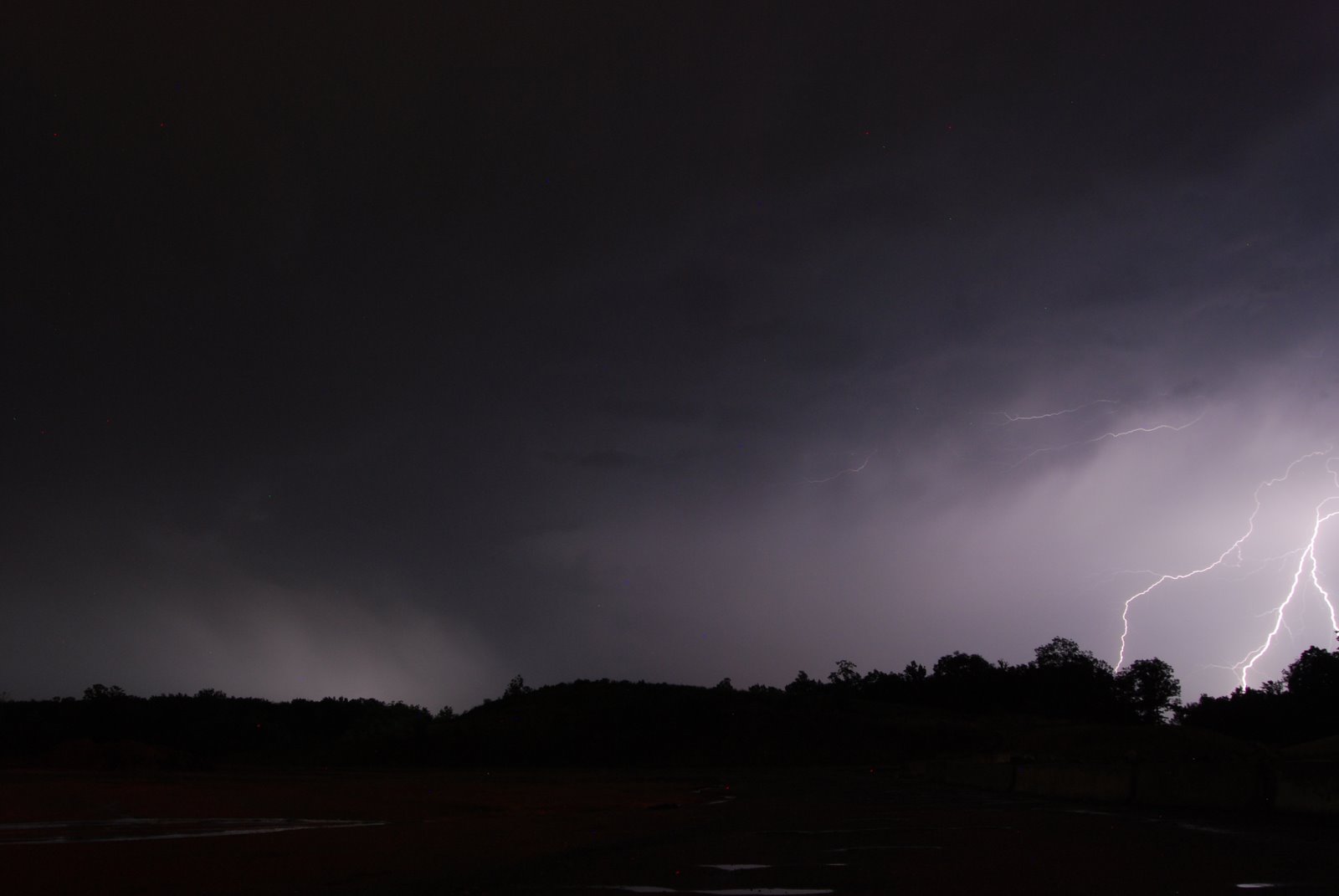
To take these photos of lightning in action, I use a Nikon DSLR in manual mode. The trick is to open up the shutter for 20 to 30 seconds, using the f-stop to control the amount of light hitting the sensor. I also adjust the ISO (sensor sensitivity) depending on whether I want to see the foreground (400) or not (100).

The difficulty with taking lightning photos is not knowing where or when they will strike. One can generally get a feel for the direction, so one points that way with a wide angle (18mm lens setting in my case) and hope for the best. The focus needs to be manually adjusted to infinity and then a notch back, since my camera overdoes it just slightly. (The same is true for astronomy pictures.) I have difficulty focusing correctly at higher zoom levels (55mm) in the dark, although in hindsight I could have used the hospital building behind me to set the focus for the horizon shots, as the focal distances are close enough.

The second difficulty is with rain. At the front of the storm, the rain blows at you and is more intense, and the lightning can be obscured by the thick rain bands. At the back of the storm, the rain hits your back and is usually just a drizzle, and the lightning is less obscured by thinner rain bands. I need to consider getting a waterproof casing, just like I would use for underwater camera use.

The back of the storm seems safer from a lightning strike perspective, but that is not necessarily true. Lightning can travel miles in any direction nearer the speed of light than not. It can fork in multiple directions, run cloud to cloud, and strike ground to cloud. The basic idea is not to be caught in the middle of any part of a lightning strike.

Have fun!


The difficulty with taking lightning photos is not knowing where or when they will strike. One can generally get a feel for the direction, so one points that way with a wide angle (18mm lens setting in my case) and hope for the best. The focus needs to be manually adjusted to infinity and then a notch back, since my camera overdoes it just slightly. (The same is true for astronomy pictures.) I have difficulty focusing correctly at higher zoom levels (55mm) in the dark, although in hindsight I could have used the hospital building behind me to set the focus for the horizon shots, as the focal distances are close enough.
The second difficulty is with rain. At the front of the storm, the rain blows at you and is more intense, and the lightning can be obscured by the thick rain bands. At the back of the storm, the rain hits your back and is usually just a drizzle, and the lightning is less obscured by thinner rain bands. I need to consider getting a waterproof casing, just like I would use for underwater camera use.

The back of the storm seems safer from a lightning strike perspective, but that is not necessarily true. Lightning can travel miles in any direction nearer the speed of light than not. It can fork in multiple directions, run cloud to cloud, and strike ground to cloud. The basic idea is not to be caught in the middle of any part of a lightning strike.

Have fun!

Sunday, July 3, 2011


Friday, June 24, 2011
Geithner Needs more Humility
CNS News is reporting testimony by Treasury Secretary Geithner regarding the Obama Administration's plan to raise taxes on small business owners. Two comments jumped out at me:
And shortly after:
In the second quote is the assertion that we as a country could not accept a smaller government. Again, this is for the Congress to decide what is priority and what is not. It is up to Congress to raise revenues or decrease spending (or both), because they are our representatives. It is the duty of the Secretary of the Treasury to advise and challenge the Congress, and afterward to do the will of Congress as enshrined in law. It is not his duty to tell Congress what the people do and do not want.
Secretary Geithner needs to be reined in. His ego has outgrown the confines of his office.
... I have to go out and borrow a trillion dollars over the next 10 years to finance those tax benefits for the top 2 percent, and I don't think I can justify doing that,” said Geithner.
And shortly after:
...then you have to do exceptionally deep cuts in benefits for middle-class Americans and you have to shrink the overall size of government programs, things like education, to levels that we could not accept as a country,” said Geithner.What struck me wrong in the first quote is the use of the pronoun "I", and the conclusion "I don't think I can justify doing that." What arrogance to think that an appointed official of the United States of America believes that he and not the Congress is the gatekeeper on how tax revenues and borrowings are balanced.
In the second quote is the assertion that we as a country could not accept a smaller government. Again, this is for the Congress to decide what is priority and what is not. It is up to Congress to raise revenues or decrease spending (or both), because they are our representatives. It is the duty of the Secretary of the Treasury to advise and challenge the Congress, and afterward to do the will of Congress as enshrined in law. It is not his duty to tell Congress what the people do and do not want.
Secretary Geithner needs to be reined in. His ego has outgrown the confines of his office.
Tuesday, June 21, 2011
Wikipedia Jokes
I have no idea if these are original, but I thought of them on my drive home today.
What's a dog's favorite encyclopedia? Lickipedia.
What's a dog's least favorite encyclopedia? Tickipedia.
What's a doctor's favorite encyclopdia? Sickipedia.
What's Disney's favorite encyclopedia? Mickeypedia.
What's a mason's favorite encyclopedia? Brickipedia.
What's Jokey Smurf's favorite encyclopedia? Trickipedia.
What's Santa's favorite encyclopedia? Nickipedia.
What's a witch's favorite encyclopedia? Wiccanpedia.
Groaners all, yet they must enter the humor of the modern web. Long live Wikipedia!
What's a dog's favorite encyclopedia? Lickipedia.
What's a dog's least favorite encyclopedia? Tickipedia.
What's a doctor's favorite encyclopdia? Sickipedia.
What's Disney's favorite encyclopedia? Mickeypedia.
What's a mason's favorite encyclopedia? Brickipedia.
What's Jokey Smurf's favorite encyclopedia? Trickipedia.
What's Santa's favorite encyclopedia? Nickipedia.
What's a witch's favorite encyclopedia? Wiccanpedia.
Groaners all, yet they must enter the humor of the modern web. Long live Wikipedia!
Thursday, June 2, 2011
Mushroom Ruins Asphalt
We've had a lot of rain recently. Evidently a mushroom quietly drank a lot of it, then suddenly burst through the edge of our one year old asphalt driveway.
Two things are tremendous about this. First, that the mushroom grew so quickly--we did not notice this damage at 8am, but noticed it at 6pm. Second, that the mushroom was capable of delivering enough hydraulic pressure *and* surviving in order to push out this asphalt.
I wonder if this would have happened if we had managed to seal the driveway first.

Two things are tremendous about this. First, that the mushroom grew so quickly--we did not notice this damage at 8am, but noticed it at 6pm. Second, that the mushroom was capable of delivering enough hydraulic pressure *and* surviving in order to push out this asphalt.
I wonder if this would have happened if we had managed to seal the driveway first.


Tuesday, May 24, 2011
Netanyahu Addresses Congress
This is the speech that Obama should have given: unequivocal, clear-headed, direct, and brave. Simply awesome.
Wednesday, May 18, 2011
Hail!
I came home this evening to find that we had received a fair amount of hail. What I found at 10PM had dropped before 7PM, and was layered more than one inch thick, consisting of round, marble-sized crystals. Wow!
The dogs were dry when Kathy came home after 7. She didn't notice the hail where she was, a few miles north, so this was highly localized.

The dogs were dry when Kathy came home after 7. She didn't notice the hail where she was, a few miles north, so this was highly localized.


Monday, May 9, 2011
The Firebird (Stravinsky)
My first introduction to Stravinsky's Firebird was through Fantasia 2000. Quite literally, a firebird came out of a volcano in a thunder of brass and percussion and chased down the Spring nymph to her doom. Fortunately, a single tear revived her from the ashes of the burned forest--the result of the firebird's brief reign of terror--and, helped by her friend the stag, triumphs over the ruined waste with seed and rain. Instantly, as the music crescendos in triumph, great trees spring up out of the ground, rising to the heights of ancient trees in mere breaths. The waste fades to memory as the story of renewal is told once more.
Well, that's the way Disney's artists saw it. And good for them! The music they selected is just a brief excerpt from the whole piece, so I was in for an experience listing to it again tonight.
Netflix was having an internal error, so I switched my Roku box to the Classical TV channel. The first item on the list was Valery Gergiev conducting the Vienna Philhamonic in Vienna in 2000. Three pieces were on the program: Prokofiev's Symphony No. 1 ("Classical"), an unwatchable modern viola concerto, and Stravinsky's Firebird. I have a hard time watching Gergiev conduct, because he has a tendency to shake his right hand about as if he has palsy. (He doesn't, as I was able to observe as he conducted the later pieces in the program.)
The great complexity of the viola concerto and of the Firebird demanded someone who could feel the music as much as memorize it. Gergiev excelled at this, especially during the Firebird, which is incredibly dynamic and expressive. By the time the orchestra plays at the concert, the conductor is generally reminding players where to come in. The task of shaping how they will play is (mostly) complete. It takes a lot of work, most of which concertgoers never see. I had the privilege of working with my college orchestra as an assistant for five years, under two directors. I learned more about composition and performance from those rehearsals than I ever did from listening to albums.
Some orchestras allow you to attend rehearsals. You may not get to hear the music non-stop, but you get the experience of learning how it is all put together. I strongly encourage experiencing music up close and personal. If you're not playing it, go wahow it is played.
Well, that's the way Disney's artists saw it. And good for them! The music they selected is just a brief excerpt from the whole piece, so I was in for an experience listing to it again tonight.
Netflix was having an internal error, so I switched my Roku box to the Classical TV channel. The first item on the list was Valery Gergiev conducting the Vienna Philhamonic in Vienna in 2000. Three pieces were on the program: Prokofiev's Symphony No. 1 ("Classical"), an unwatchable modern viola concerto, and Stravinsky's Firebird. I have a hard time watching Gergiev conduct, because he has a tendency to shake his right hand about as if he has palsy. (He doesn't, as I was able to observe as he conducted the later pieces in the program.)
The great complexity of the viola concerto and of the Firebird demanded someone who could feel the music as much as memorize it. Gergiev excelled at this, especially during the Firebird, which is incredibly dynamic and expressive. By the time the orchestra plays at the concert, the conductor is generally reminding players where to come in. The task of shaping how they will play is (mostly) complete. It takes a lot of work, most of which concertgoers never see. I had the privilege of working with my college orchestra as an assistant for five years, under two directors. I learned more about composition and performance from those rehearsals than I ever did from listening to albums.
Some orchestras allow you to attend rehearsals. You may not get to hear the music non-stop, but you get the experience of learning how it is all put together. I strongly encourage experiencing music up close and personal. If you're not playing it, go wahow it is played.
Monday, May 2, 2011
Royal Wedding Fever
I am a true Natural Born United States Citizen, but I was born in Australia to American parents, and my father's heritage runs blue-blood from England and Scotland. I have a soft spot for the marches of Elgar and the magnificent cathedrals and abbeys of London, so it is no surprise that I like royal weddings.
I first watched the wedding of Prince Charles and Princess Diana in 1991, when it was rebroadcast on A&E. Being a softie for this sort of thing, I taped it. My wife hasn't watch it, but she did seem to like watching the most recent royal wedding when it was rebroadcast (same-day) on BBC America. Little does she know that I modeled our own wedding ceremony (but far more spartanly) on Charles' and Diana's. I so loved the old language of the service, that we based our vows on the old Book of Common Prayer.
I have visited Westminster Abbey, and I wondered so much how they could pull off a wedding there. With unparalleled photographic access, the BBC showed us how. I was especially happy to see the trees inside, with their young light green leaves glowing under the bright lights. St. Paul's Cathedral (the site of Charles' and Diana's wedding) is much larger and better lit by the sun, but Westminster is no less beautiful for a wedding.
We waited until the bridal couple returned from signing the register before we thought about turning off the television. I wanted to hear the household trumpeters deliver the fanfare--and what a job they did! That was the best moment for me of the 1981 royal wedding (and I finally found a recording), so I especially wanted to see what they did in 2011.
For me, most weddings are musical. I helped my mother and her best friend play piano and organ duets at several weddings (I was a page turner), and this has stuck with me. The 1981 royal wedding was far more musical, with three orchestras, a few choirs, soprano Kiri te Kanawa, and spirited classical music from Clarke, Handel, and Elgar. I like the Walton march used as the 2011 recessional less than I like Elgar's Pomp & Circumstance March #4, but it was well-played--better in fact than many recordings I have heard.
Next time you go to a wedding, pay attention to the music. Usually there is a lot of thought that goes into choosing each piece, and certainly there is a lot of effort in performing it. You might be able to read the bride and groom a little better as a result.
I first watched the wedding of Prince Charles and Princess Diana in 1991, when it was rebroadcast on A&E. Being a softie for this sort of thing, I taped it. My wife hasn't watch it, but she did seem to like watching the most recent royal wedding when it was rebroadcast (same-day) on BBC America. Little does she know that I modeled our own wedding ceremony (but far more spartanly) on Charles' and Diana's. I so loved the old language of the service, that we based our vows on the old Book of Common Prayer.
I have visited Westminster Abbey, and I wondered so much how they could pull off a wedding there. With unparalleled photographic access, the BBC showed us how. I was especially happy to see the trees inside, with their young light green leaves glowing under the bright lights. St. Paul's Cathedral (the site of Charles' and Diana's wedding) is much larger and better lit by the sun, but Westminster is no less beautiful for a wedding.
We waited until the bridal couple returned from signing the register before we thought about turning off the television. I wanted to hear the household trumpeters deliver the fanfare--and what a job they did! That was the best moment for me of the 1981 royal wedding (and I finally found a recording), so I especially wanted to see what they did in 2011.
For me, most weddings are musical. I helped my mother and her best friend play piano and organ duets at several weddings (I was a page turner), and this has stuck with me. The 1981 royal wedding was far more musical, with three orchestras, a few choirs, soprano Kiri te Kanawa, and spirited classical music from Clarke, Handel, and Elgar. I like the Walton march used as the 2011 recessional less than I like Elgar's Pomp & Circumstance March #4, but it was well-played--better in fact than many recordings I have heard.
Next time you go to a wedding, pay attention to the music. Usually there is a lot of thought that goes into choosing each piece, and certainly there is a lot of effort in performing it. You might be able to read the bride and groom a little better as a result.
Subscribe to:
Posts (Atom)