Friday, June 1, 2012

Expanding and Contracting the definition of "Marriage"?

A recent letter to the editor (not by me) entitled by the editor "If gays, lesbians marry, why not relatives?" related the defense given by many, that "two consenting adults [have constitutional rights] to marry whom they love".  The author of the letter took issue with this defense, logically concluding that it could be used as justification for incestuous marriage.  Readers of the letter were not kind, calling this a "slippery slope" and calling the comparison of same-sex marriage with incestuous marriage a "nonsense argument".

My interpretation is that the readers overreacted.  In their rush to defend same-sex marriage, they overlooked the actual thesis of the letter.  The letter took issue with the simplistic defense, not with the actual merits of same-sex marriage.  My efforts to defend the author on these grounds were themselves attacked (with some bringing in the topics of cannibalism and rape), as if I too had stated that same-sex marriage was equivalent to incestuous marriage (or rape or cannibalism).

After a little back and forth, a real debate emerged.  My opponent cited the 14th Amendment to the U.S. Constitution, whose "Equal Protection Clause" reads

[N]or shall any State ... deny to any person within its jurisdiction the equal protection of the laws.

He reasonably simplified this clause as "similarly-situated citizens must be treated the same by the State," and asserted that same-sex couples were similarly situated to opposite-sex couples, and that incestuous couples and polygamous couples are not similarly situated.  His assertion led me to point out that people are most likely to disagree whether same-sex couples are in fact similarly situated.

The disagreement should involve statements regarding the State's fundamental interest in promoting the effects of marriage; for, why would the State erect such a powerful legal framework of inheritance, medical rights, incentives for generating offspring and responsibilities for rearing them, etc.?  Surely not merely to protect the right of two consenting adults to join in a contract.

The most significant and irrefutable difference between same-sex couples and opposite-sex couples has to do with reproduction.  It is a fact that same-sex couples cannot naturally create offspring wholly within the circle of their own inherent biological capabilities.  It requires human intervention from outside the circle, such as through sperm or egg donation, or the use of a surrogate parent.  (It can be argued that many opposite-sex couples must resort to these methods as well, but as a class, opposite-sex couples together have the reproductive capability that same-sex couples do not.)

The question arises: Is reproduction one of the State's fundamental interests in promoting opposite-sex marriage?  If so, is the absence of this ability in part of the population, especially in today's age of advanced reproductive technology and a legal system sympathetic to artificial reproduction, sufficient to declare same-sex couples "not similarly situated" and so deny the right to marry?  Reasonable people will disagree, and hostile debate will not bring the many sides closer to understanding.  This is a matter of philosophy, not of fact.

It would seem that in all other ways, same-sex couples are similarly situated.  They share a desire with opposite-sex couples for a special familial integration, recognized with the full majesty and force of law, of two lives full of income and property, offspring (whether adopted or not), and the power to make joint decisions and be a pre-eminent part of each other's lives.

Civil Unions were introduced to offer this second, more sweeping, legal aspect of marriage, but is argued by many to be inadequate because the institution is "separate but equal" to marriage.  To determine why they are separate, it is necessary to determine what the State's justification is for promoting marriage, as opposed to allowing civil unions.  It is for the people of each State to decide the answer to that question, and the rationale used to answer the question matters, which brings us back to the author of the letter to the editor.

If marriage is justified solely in legal terms, resting especially on the general right of consenting adults to contract with one another as they choose, then it should come as no surprise when any consenting adults wish to enter into any contract with one another as they choose.  It is still reasonable for the State to determine the extent to which such a contract is legal, but the State must justify each limitation, and that may be scientific (as with incestuous relationships), or social-scientific (as with polygamous relationships).

If, however, some justification is couched in philosophical terms (whether in addition to or in lieu of scientific or social-scientific evidence), then the contractual limits may be arbitrary, subject only to the collective will of the electorate.  This is, I believe, where the same-sex marriage debate actually stands.  The will of the electorate of the past is being challenged in legislatures and courthouses by the electorate of today.  Some State legislatures have embraced same-sex marriage (though often at the prompting of the judiciary); others have rejected it, even to the extent of enshrining their opposition with that of the electorate directly into their State constitutions.

The people are speaking.  Some have determined that same-sex couples are similarly situated to opposite-sex couples.  In this respect, I believe that they have contracted the definition of marriage, by eliminating** the possible justifications that the State may have for promoting only opposite-sex marriage.  They have, however, expanded the number of people eligible to be married, and so this is likely the source in popular usage of "expansion of marriage rights".  (**It is possible that new justifications specific to same-sex couples could be added, but I have not observed these.  Equality of same-sex couples seems to be the primary reason, not their superiority; the superiority of opposite-sex couples has been claimed by many opposite-sex marriage proponents.)

Likewise, some have determined that same-sex couples are not similarly situated.  Whether these people have expanded or restored or clarified the definition of marriage is difficult to say, as the definition of marriage comes down to us from so many different paths through history, and is touched by both fact and falsehood.

It would be sufficient, in an ideal sense, that both of these groups of people, both pro and con, have chosen to re-examine their personal justifications for marriage and collectively written new definitions that are acceptable to them in their States.  In truth, perhaps many have undertaken this re-examination with solemn conviction, but likely many others have reacted from lesser motivations, ranging from ignorance to selfish desire.  I lament that so many on opposing sides reduce to hurling insults and epithets, and arguing only on emotional grounds, none of which serves the common interest, and all of which disrespects someone's individual interest.  Once again, the limitations of representative democracy reveal the flaws in our system of government as it has evolved to the present day.

In all cases, oversimplification of the arguments for or against same-sex marriage, especially when enshrined in law, can lead to heretofore absurd or undesired conclusions.  Get educated on the complexity of the arguments, and form studied opinions before rendering them.

Monday, December 19, 2011

How to prevent licking an abdominal incision

Scarlett recently had surgery to remove a cancerous skin tumor from her abdomen. She was absolutely pitiful with the e-collar, so Kathy first used a long-sleeve shirt with a dog cape to keep Scarlett's tongue from the stitches. We upgraded stylistically to flannel this evening, and should trip Scarlett less than the prototype did. It's cute, and it means we get a full night's rest (unlike the first night, when I slept on the floor with her sans e-collar).

Prototype


Final Version

Thursday, November 10, 2011

Occupy "Here" Disappointment

I have been very disappointed in the immaturity and criminality associated with the "Occupy" movement. Having been to at least one Tea Party rally, I can attest to the sharp difference between the two crowds.

Although both are rightfully (to an extent) railing against financial excesses, the "Occupy" movement seems to have misunderstood their civic right to peaceably assemble and petition for redress of grievances. Whereas the Tea Party rallies emboldened people to go home and seek electoral change, the "Occupy" movement seems to be stuck in urban locations making a nuisance.

The level of crime that has sprung up around these camps is more than sufficient to demonstrate a stark difference from the Tea Party rallies. We should be as shocked about the crimes happening in the camps as we are about the child abuse that occurred at Penn State.

We should celebrate our right to assemble, but show disdain for those who abuse it. We cannot--and should not--send them to jail for assembling. But we can turn our backs on them, and we can support Mayors who work to arrest the lawbreakers.

Saturday, November 5, 2011

Scottish Stormtropper


Photographed last weekend at the Highland Games and Celtic Festival at the Meadow Event Park in Caroline County, Virginia.
Posted by Picasa

Tuesday, August 23, 2011

Even the earthquakes are leaving California

Yesterday and today, Colorado had significant earthquakes. Today, Virginia had a 5.9 quake about an hour's drive from my home.

Perhaps taxpayers are not the only ones leaving California!

Sunday, August 21, 2011

Journalistic Misuse of Photography: Example


(JOHN GILES/ASSOCIATED PRESS)

The above picture appears at the head of Ezra Klein's article "Getting ready for a wave of coal-plant shutdowns".

I want to take issue with what I think is a misleading use of photography in a journalistic setting. First, my qualifications: I am a competent amateur photographer, I live near two clean-coal plants, and have toured one of them as a volunteer firefighter.

This picture is tied to comments about coal-fired power plants being idled and remaining coal-fired power becoming more expensive as a result of new EPA regulations. The picture appears at first to be of a dirty smoke pouring out of the stack. This simply is not true. The stack in question is a water-spray column through which smoke is directed *after* it has gone through a first-stage ash filter. (The ash is often consumed by landfills and concrete manufacturers.) The cloud emerging from the stack is in fact nothing more than steam. (There are invisible gases emerging as well, such as Carbon Dioxide.)

The photographer has imaged the cloud with the sun behind it. Then using exposure bracketing, he has formed a High Dynamic Range photo, which enhances the shadowed areas without blowing out the bright areas. This leads to simple white steam appearing dark and fringed by white.

In the winter, this steam lingers along the wind for thousands of feet before finally behind cooled and absorbed into the air. In summer, the steam is rarely visible more than a few hundred feet, except when high humidity in the air--such as during a heavy rain storm--prevents rapid absorption of the humidity.

In short, the photograph displayed is completely misused for the article to which it is applied. It is a lapse of editorial integrity to combine the two.

Thursday, July 14, 2011

A Question of Procedure

In congress, ordinary procedure calls for a bill to be submitted to committees having jurisdiction over the subject area. Once the committees have amended the bill, if they approve, then the bill will go to the floor to be amended again, then voted up or down (or sometimes pulled from consideration).

Watching the Congress and the President wrestle over the debt ceiling and the deficit is like watching bad theater. None of this is business as usual. There are 435 members in the House of Representatives, and 100 senators in the Senate. Each is assigned to various committees and subcommittees. The budget committees have proper jurisdiction over the level of appropriations, and should be the ones doing the heavy lifting in this time of "crisis." They are not, and so we have stepped away, yet again, from normal procedure.

I say "yet again" because Speaker Pelosi bypassed the committees several times to get what she wanted. This represents yet another critical breakdown in the legislative process.

What should be happening? How about this:

1) The Democrats in the House draft a revenue bill plus debt ceiling increase and work to bring it to the floor for a vote. The Republicans let them, knowing that they have the overwhelming "Nay" votes.

2) The Senate cannot constitutionally bring forward a revenue bill, so the Democrat-controlled Senate is limited to formulating and voting on a spending reduction plus debt ceiling increase bill. The Republicans work to shape the bill, but do not filibuster.

3) The House proceeds to consider Republican and/or Democrat spending reduction plus debt ceiling increase bills. One of these will pass, probably the Republican bill.

4) The two chambers appoint a joint committee to reconcile the two bills. Many concessions are discussed, and either the committee comes to agreement or it does not. If it comes to agreement, then both chambers attempt to pass the jointly-revised bill. Otherwise, the bill is dead.

5) If both chambers pass the revised bill, then it goes to the President for signature. If he doesn't like it, he vetoes it. Otherwise, he lets it pass into law.

6) If the President vetoes the bill, then the Congress must vote to override it. To muster veto-proof support, the bill must be palatable to 2/3 of each chamber, a good definition of bipartisanship.

7) If Congress cannot override the veto, then the bill is dead.

So, at which point in the process is it who's fault if the bill does not pass? In truth, everyone's prints are all over the corpse, and all are responsible. Republicans are responsible if they produce a bill that the Senate cannot reconcile to. Democrats are responsible if they produce a bill that the House cannot reconcile to. The President is responsible if a reasonable majority approve a critical bill and he vetoes it.

The American people aren't supposed to know the ins and outs of legislative procedure. What's in the Constitution is a good enough, high-level description. But we should know that the procedure is fair and representative, and that it is deviated from only in times of great national danger.

What is happening now is a government-made national danger. It is shameful that reckless spending and borrowing have occurred and have now brought us to this point. It is imperative to re-infuse the process with representativeness and fairness.

Following an expedited form of the process above would give Democrats in the House something that Speaker Pelosi refused to give Republicans in the House: a fair chance to have their legislation voted up or down. If they want tax increases, then let them try to muster enough support for a vote. If it fails, proceed with the only option that remains: spending reductions.

Above all, let the voice of the people, through their Representatives in the House, be heard by the Senate and the President. Let the opposition stand aside when they lose the vote. Let the victor move forward confidently and with humility when they win the vote.

Maybe then, we'll get a functioning legislative branch.

Monday, July 11, 2011

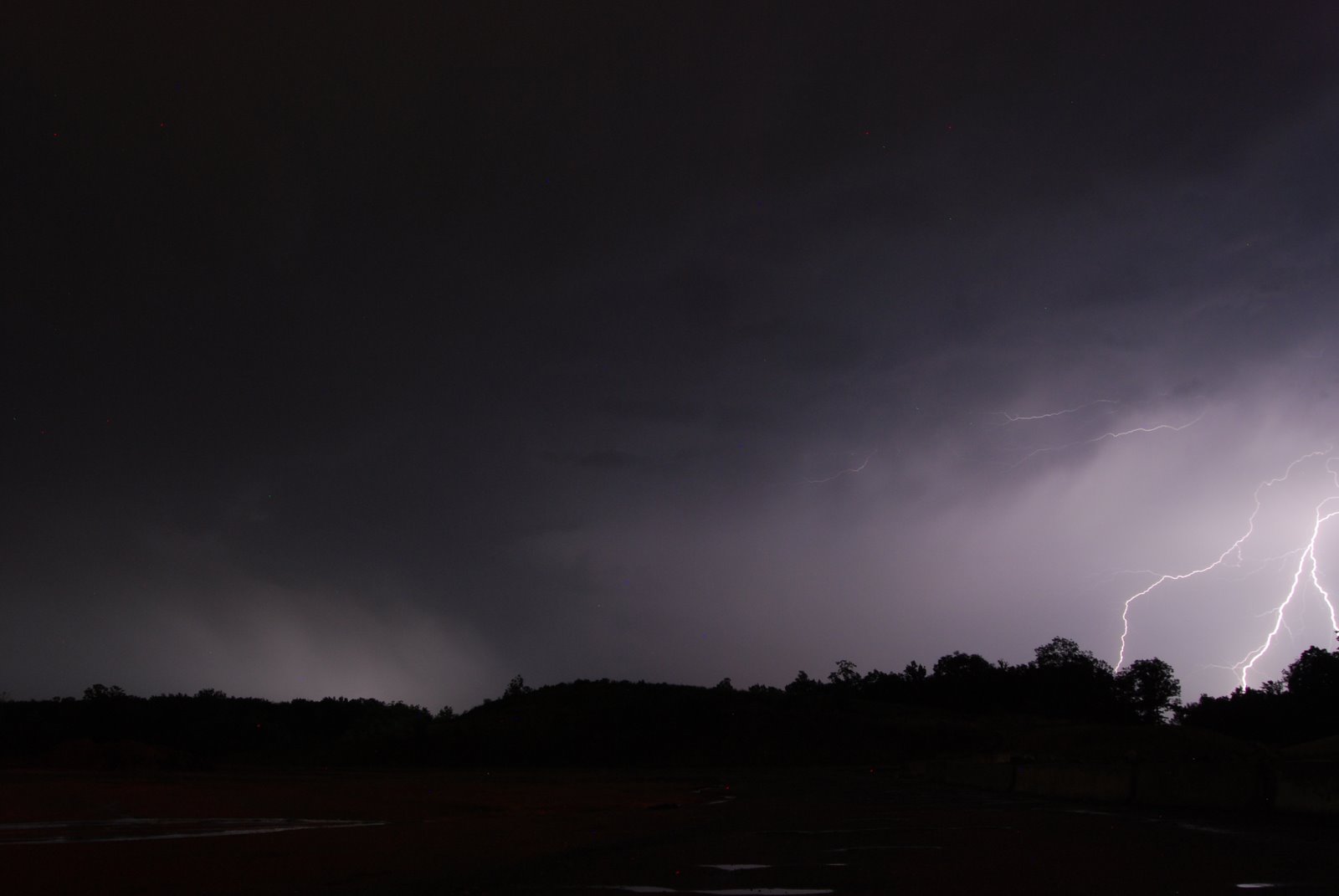
Taking Lightning Photos

To take these photos of lightning in action, I use a Nikon DSLR in manual mode. The trick is to open up the shutter for 20 to 30 seconds, using the f-stop to control the amount of light hitting the sensor. I also adjust the ISO (sensor sensitivity) depending on whether I want to see the foreground (400) or not (100).
 

The difficulty with taking lightning photos is not knowing where or when they will strike. One can generally get a feel for the direction, so one points that way with a wide angle (18mm lens setting in my case) and hope for the best. The focus needs to be manually adjusted to infinity and then a notch back, since my camera overdoes it just slightly. (The same is true for astronomy pictures.) I have difficulty focusing correctly at higher zoom levels (55mm) in the dark, although in hindsight I could have used the hospital building behind me to set the focus for the horizon shots, as the focal distances are close enough.
 

The second difficulty is with rain. At the front of the storm, the rain blows at you and is more intense, and the lightning can be obscured by the thick rain bands. At the back of the storm, the rain hits your back and is usually just a drizzle, and the lightning is less obscured by thinner rain bands. I need to consider getting a waterproof casing, just like I would use for underwater camera use.
 

The back of the storm seems safer from a lightning strike perspective, but that is not necessarily true. Lightning can travel miles in any direction nearer the speed of light than not. It can fork in multiple directions, run cloud to cloud, and strike ground to cloud. The basic idea is not to be caught in the middle of any part of a lightning strike.
 

Have fun!
 

Sunday, July 3, 2011

Lightning Storm

Took these pictures this evening from the end of my driveway.


Posted by Picasa

Friday, June 24, 2011

Geithner Needs more Humility

CNS News is reporting testimony by Treasury Secretary Geithner regarding the Obama Administration's plan to raise taxes on small business owners.  Two comments jumped out at me:
... I have to go out and borrow a trillion dollars over the next 10 years to finance those tax benefits for the top 2 percent, and I don't think I can justify doing that,” said Geithner.

And shortly after:
...then you have to do exceptionally deep cuts in benefits for middle-class Americans and you have to shrink the overall size of government programs, things like education, to levels that we could not accept as a country,” said Geithner.
What struck me wrong in the first quote is the use of the pronoun "I", and the conclusion "I don't think I can justify doing that."  What arrogance to think that an appointed official of the United States of America believes that he and not the Congress is the gatekeeper on how tax revenues and borrowings are balanced.

In the second quote is the assertion that we as a country could not accept a smaller government.  Again, this is for the Congress to decide what is priority and what is not.  It is up to Congress to raise revenues or decrease spending (or both), because they are our representatives.  It is the duty of the Secretary of the Treasury to advise and challenge the Congress, and afterward to do the will of Congress as enshrined in law.  It is not his duty to tell Congress what the people do and do not want.

Secretary Geithner needs to be reined in.  His ego has outgrown the confines of his office.

Tuesday, June 21, 2011

Wikipedia Jokes

I have no idea if these are original, but I thought of them on my drive home today.

What's a dog's favorite encyclopedia?  Lickipedia.
What's a dog's least favorite encyclopedia?  Tickipedia.

What's a doctor's favorite encyclopdia?  Sickipedia.

What's Disney's favorite encyclopedia?  Mickeypedia.

What's a mason's favorite encyclopedia?  Brickipedia.

What's Jokey Smurf's favorite encyclopedia?  Trickipedia.

What's Santa's favorite encyclopedia?  Nickipedia.

What's a witch's favorite encyclopedia?  Wiccanpedia.

Groaners all, yet they must enter the humor of the modern web.  Long live Wikipedia!

Thursday, June 2, 2011

Mushroom Ruins Asphalt

We've had a lot of rain recently. Evidently a mushroom quietly drank a lot of it, then suddenly burst through the edge of our one year old asphalt driveway.

Two things are tremendous about this. First, that the mushroom grew so quickly--we did not notice this damage at 8am, but noticed it at 6pm. Second, that the mushroom was capable of delivering enough hydraulic pressure *and* surviving in order to push out this asphalt.

I wonder if this would have happened if we had managed to seal the driveway first.


Posted by Picasa

Tuesday, May 24, 2011

Netanyahu Addresses Congress

This is the speech that Obama should have given: unequivocal, clear-headed, direct, and brave.  Simply awesome.

Wednesday, May 18, 2011

Hail!

I came home this evening to find that we had received a fair amount of hail. What I found at 10PM had dropped before 7PM, and was layered more than one inch thick, consisting of round, marble-sized crystals. Wow!

The dogs were dry when Kathy came home after 7. She didn't notice the hail where she was, a few miles north, so this was highly localized.


Posted by Picasa

Monday, May 9, 2011

The Firebird (Stravinsky)

My first introduction to Stravinsky's Firebird was through Fantasia 2000.  Quite literally, a firebird came out of a volcano in a thunder of brass and percussion and chased down the Spring nymph to her doom.  Fortunately, a single tear revived her from the ashes of the burned forest--the result of the firebird's brief reign of terror--and, helped by her friend the stag, triumphs over the ruined waste with seed and rain.  Instantly, as the music crescendos in triumph, great trees spring up out of the ground, rising to the heights of ancient trees in mere breaths.  The waste fades to memory as the story of renewal is told once more.

Well, that's the way Disney's artists saw it.  And good for them!  The music they selected is just a brief excerpt from the whole piece, so I was in for an experience listing to it again tonight.

Netflix was having an internal error, so I switched my Roku box to the Classical TV channel.  The first item on the list was Valery Gergiev conducting the Vienna Philhamonic in Vienna in 2000.  Three pieces were on the program:  Prokofiev's Symphony No. 1 ("Classical"), an unwatchable modern viola concerto, and Stravinsky's Firebird.  I have a hard time watching Gergiev conduct, because he has a tendency to shake his right hand about as if he has palsy.  (He doesn't, as I was able to observe as he conducted the later pieces in the program.)

The great complexity of the viola concerto and of the Firebird demanded someone who could feel the music as much as memorize it.  Gergiev excelled at this, especially during the Firebird, which is incredibly dynamic and expressive.  By the time the orchestra plays at the concert, the conductor is generally reminding players where to come in.  The task of shaping how they will play is (mostly) complete.  It takes a lot of work, most of which concertgoers never see.  I had the privilege of working with my college orchestra as an assistant for five years, under two directors.  I learned more about composition and performance from those rehearsals than I ever did from listening to albums.

Some orchestras allow you to attend rehearsals.  You may not get to hear the music non-stop, but you get the experience of learning how it is all put together.  I strongly encourage experiencing music up close and personal.  If you're not playing it, go wahow it is played.

Monday, May 2, 2011

Royal Wedding Fever

I am a true Natural Born United States Citizen, but I was born in Australia to American parents, and my father's heritage runs blue-blood from England and Scotland.  I have a soft spot for the marches of Elgar and the magnificent cathedrals and abbeys of London, so it is no surprise that I like royal weddings.

I first watched the wedding of Prince Charles and Princess Diana in 1991, when it was rebroadcast on A&E.  Being a softie for this sort of thing, I taped it.  My wife hasn't watch it, but she did seem to like watching the most recent royal wedding when it was rebroadcast (same-day) on BBC America.  Little does she know that I modeled our own wedding ceremony (but far more spartanly) on Charles' and Diana's.  I so loved the old language of the service, that we based our vows on the old Book of Common Prayer.

I have visited Westminster Abbey, and I wondered so much how they could pull off a wedding there.  With unparalleled photographic access, the BBC showed us how.  I was especially happy to see the trees inside, with their young light green leaves glowing under the bright lights.  St. Paul's Cathedral (the site of Charles' and Diana's wedding) is much larger and better lit by the sun, but Westminster is no less beautiful for a wedding.

We waited until the bridal couple returned from signing the register before we thought about turning off the television.  I wanted to hear the household trumpeters deliver the fanfare--and what a job they did!  That was the best moment for me of the 1981 royal wedding (and I finally found a recording), so I especially wanted to see what they did in 2011.

For me, most weddings are musical.  I helped my mother and her best friend play piano and organ duets at several weddings (I was a page turner), and this has stuck with me.  The 1981 royal wedding was far more musical, with three orchestras, a few choirs, soprano Kiri te Kanawa, and spirited classical music from Clarke, Handel, and Elgar.  I like the Walton march used as the 2011 recessional less than I like Elgar's Pomp & Circumstance March #4, but it was well-played--better in fact than many recordings I have heard.

Next time you go to a wedding, pay attention to the music.  Usually there is a lot of thought that goes into choosing each piece, and certainly there is a lot of effort in performing it.  You might be able to read the bride and groom a little better as a result.

Osama Bin Laden is Dead!

Go Navy!  SEAL Team 6 did the deed, taking out the bad guy in a remarkably resilient operation.  Kudos to former President Bush and current President Obama for supporting the military and intelligence apparatus that finally put this mission success in the history books.

The war is not over--this snake has many heads--but a shiver should now be running through the world of Islamic fanaticism.  We can put the pieces together.  We can kill or capture terrorists and their leaders, before they have a chance to do their worst.  We may be slow to learn, but we are fast and strong once we strike.

This is a proud day for the U.S. and its allies.  It's definitely a morale booster for all of us.

P.S.  I wonder if this is why William and Kate did not go abroad for their honeymoon.  It is reasonable to assume that U.K. Prime Minister David Cameron was informed, since the U.S. knew in mid-March where Osama was living, and that he would have informed the Palace and MI5 of the risks.

Absences from Writing

I've been away since mid-February?!  This has been a tough spring on the business front.  Just when we think we have something finally under control, it busts loose again.

It's also been tough on the family front.  My grandmother passed away two weeks ago, aged 87.  I was able to see her before she went.  I flew standby to Arizona and back, and made all of my flights.

Now it is May.  "Get up, get up for shame!  The blooming morn / Upon her wings presents the god unshorn." [Robert Herrick]  The time has come to get back into writing.  There is a lot going on in the world, and I should not be so passive.

Monday, February 14, 2011

Thursday, February 10, 2011

Employees' Share of Profits? What about Share of Revenues?

On Monday, President Obama spoke to the U.S. Chamber of Commerce.  Part of his speech struck me wrong, and I want to comment on that.

From the text of his speech (available on the White House's web site):

Of course, your responsibility goes beyond recognizing the need for certain standards and safeguards. If we’re fighting to reform the tax code and increase exports to help you compete, the benefits can’t just translate into greater profits and bonuses for those at the top. They have to be shared by American workers, who need to know that expanding trade and opening markets will lift their standards of living as well as your bottom line.

The interpretation on the Right seems to be that Obama is calling for profits to be shared with workers.  The interpretation on the Left seems to be the same.  In fact, he called for sharing the benefits of a reformed corporate tax code and trade rules.  The paragraphs that followed look toward better wages and benefits, believing that a worker who can afford to buy the product his company makes is the kind of worker we want to create in America.

Kathy and I recently confronted this situation in our Animal Hospital.  Because of the high cost of constructing the facility and purchasing equipment, and the steadily increasing costs of supplies, pharmaceuticals and labor, we had to charge prices higher than older established businesses that built up during cheaper times.  The other four hospitals that opened (or changed ownership) within two years (plus or minus) of ours had prices at or above our own.  Our staff finally told us that they were having a hard time affording veterinary care, and asked what we could do to help.  They asked this despite a major reduction in prices in December and the institution of a Bonus Bucks forward discount program, and despite the deep discounts we can offer up to the tax-free limit.

As a general rule, the average worker should be able to afford the average price of an average product.  When there is an imbalance, standard of living will decrease (average price above average wage), or it will increase (average wage above average price).  The first outcome risks economic recession if prolonged; the second risks inflation and eventual economic recession if the imbalance is too great.

The President is talking about making changes that will reduce expenses for businesses paying corporate taxes and trade tariffs.  What he wants is for some of the savings to be shifted to labor in the form of higher wages rather than flow straight through to management bonuses and increased equity or dividends for owners.  As a request, this is fine.  If legislated, I will have a huge problem with this.

One of the standard complaints of liberals is income inequality and how the share of national income is skewed toward the super-rich.  The facts always seem to be in dispute.  The IRS data provides the best source for longitudinal studies.  It is important to strip out those taxpayers who report sizable one-time boosts in income (such as retirees who sell a large family home with a cost basis much lower due to decades of inflation), and to look at taxpayers over time (to account for dynamic effects due to customary increases in wages over time, e.g. as one becomes a more valuable worker through the years until retirement) in order to arrive at how many are truly super-rich and how much income they actually have.  (See this 2004 study for an excellent discussion on the pitfalls of using aggregated data incorrectly.)

What is commonly demonized is profits, as if these are solely the dominion of the super-rich.  In fact, profits are nothing more than the leftovers after expenses, including labor, are paid.  This table (Excel spreadsheet) from the IRS breaks down tax-paying business financials from the year 2003 (the latest year for which this data is available).  In it we find that 27.5 million businesses earned $24.5 trillion in revenues.  Of this, $13.2 trillion (54%) was paid in Cost of Goods Sold; $2.4 trillion (10%) was paid to labor in the form of salaries, wages and benefits; $470 billion (2%) went to government in the form of taxes; $900 billion (4%) was paid to creditors in the form of interest; and $800 billion (3%) was deducted for cost of assets purchased prior to 2003, reimbursing the business for the initial outlay, but often actually covering principal payments to creditors.  The leftovers, in the form of profits and losses, were $1.4 trillion (6%) together, or separately $2 trillion (8%) in profits and $600 billion (2%) in losses.

Did you catch the part where labor's share is 10%, and the part where the owners' share is 6%?  Furthermore, some businesses lost $600 billion collectively.  They might be starting out, or failing, or having a bad year.  That loss is significant.  Labor may lose a job temporarily, but owners may lose investment permanently.  Labor has more chance of getting a new job (or social assistance) than an owner has of regaining investment.

The unemployed get 0%, which will dilute the share to labor, but I don't think that 10% unemployment is going equalize the labor share with owner share (from 10% to 6%).  (The unemployment figure in 2003 was in the neighborhood of 5%, when the 10% share to labor occurred.)

If you want the laboring classes more like the super-rich, help them invest in profitable companies.  The way for labor to get a share of profits is to buy equity in the companies that earn profits.  For the right price, current owners will part with their equity.  The government regulates a vast market for buying and selling equity, so there is little excuse for labor not to partake.  Two things will occur as a result:  the super-rich will exchange income-generating assets for neutral cash, which they will either re-invest in new businesses, or else consume (via other businesses) products and services.  If they do the former, they create new jobs.  If they do the latter, they recycle the cash into the economy on things that do not generate future income for themselves, thus reducing their long-term wealth, and sustain and perhaps grow new jobs already in the economy.  Meanwhile, the laboring class will increase their long-term wealth by deriving income from more than just their labor.  They may not become rich, but they will have less excuse to be poor.